•  
  •  
  • Trade With Us
    • Products
    • CFD Stocks
    • CFD Forex
    • CFD Commodities
    • CFD Oil Trading
    • CFD Silver Trading
    • Index CFDs
    • Trading Conditions
    • Spreads
    • Swap Rates
    • Deposit & Withdrawals
    • Dividends
  • What We Offer
    • Account Types
    • Aussie Premium
    • Standard Account
    • Pro Account
    • Refer A Friend
    • Education
    • Webinar
  • Platforms & Tools
    • Trading Platforms
    • MetaTrader 4
    • MetaTrader 5
    • Webtrader4
    • Webtrader5
  • About Us
    • Who We Are
    • Legal Documents
    • Human Resources
    • Support
    • FAQ
    • Glossary
LOGIN
Search LOGIN
  • Trade With Us
    • Products
    • CFD Stocks
    • CFD Forex
    • CFD Commodities
    • CFD Oil Trading
    • CFD Silver Trading
    • Index CFDs
    • Trading Conditions
    • Spreads
    • Swap Rates
    • Deposit & Withdrawals
    • Dividends
  • What We Offer
    • Account Types
    • Aussie Premium
    • Standard Account
    • Pro Account
    • Refer A Friend
    • Education
    • Webinar
  • Platforms & Tools
    • Trading Platforms
    • MetaTrader 4
    • MetaTrader 5
    • Webtrader4
    • Webtrader5
  • About Us
    • Who We Are
    • Legal Documents
    • Human Resources
    • Support
    • FAQ
    • Glossary
 
  • Fairmarkets Australia
  • Fairmarkets International

Index CFDs

Trade With Us Products Index CFDs

Trade global stock index CFDs


Trade the NASDAQ, DOW, ASX 200 and more

What Is Index CFD?

Indices, plural of an index, refer to a basket of different assets that are a sector or entirety of a market, most often of the same country. Indices trading is a kind of shortcut for investors when investing in financial markets without having to invest in company stocks. It's also a way of reducing risk rather than buying and selling particular company shares. Investors who choose this way trade an index or compilation of shares. 

An index is a list of publicly traded companies and their stock prices. Every index tracks a certain number of companies in the country. This means an index signs the total performance of a selected group of stocks. If the price of shares of the companies within the index increase, the value of the index also increases. If the price falls, the value of the index will go down.

By indices trading, traders directly interact with a segment of the market instead of shareholding in a single company. Trading indices allow traders to evade the possible high volatility of investing in a company by adding many other companies to the equation, thus justifying the potential impacts. 

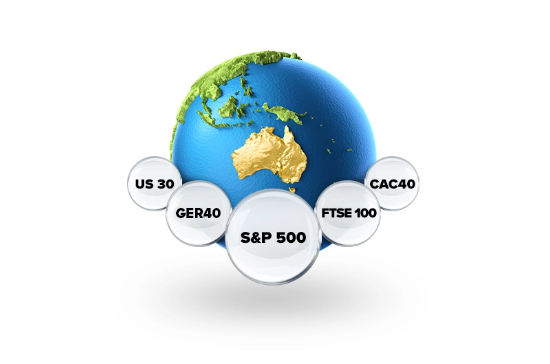
The most actively traded trading indices are often referred to as "Benchmark Indices" since they significantly impact global indices markets. Their stock indices are considered an indicator of economic growth and performance. The most active Benchmark Indices are:


  • The FTSE 100: represents the UK's largest 100 companies and is mostly referred to as "the UK 100"
  • Dow Jones: also known as "Wall Street," consists of the USA's 30 publicly-owned corporations.
  • The DAX: consists of Germany's prime 40 companies and is also referred to as the "German 40."
  • CAC40: more commonly called "France 40" and represents France's biggest capitalized 40 companies 
  • Nikkei 225: formed out of Japan's 225 price-wise leading companies, thus more often called "Japan 225"
  • NASDAQ 100: is a capital-oriented index that comprises even more than 100 tech industry companies in the USA, therefore also referred to as "The US Tech 100."

Although every member of the index affects the index's performance, trading indices allow traders to engage in stock marketing at a macro-alike level and to benefit from market movements. 


LEVERAGE

ASIC has imposed conditions on the issue and distribution of CFDs to retail clients. These conditions will be in place from 29 March 2021 to 29 September 2022, after which time they may be extended or made permanent.

From 29 March 2021, CFD leverage offered to retail clients will be restricted to a maximum ratio of:

- 30:1 for CFDs referencing an exchange rate for a major currency pair.

- 20:1 for CFDs referencing an exchange rate for a minor currency pair, gold, or a major stock market index.

- 10:1 for CFDs referencing a commodity (other than gold) or a minor stock market index.

- 2:1 for CFDs referencing crypto-assets.

- 5:1 for CFDs referencing shares or other assets.

©2026 FairMarkets All Rights Reserved

  • Markets
  • CFD Forex
  • CFD Commodities
  • CFD Indices
  • Platforms & Tools
  • MetaTrader 4
  • MetaTrader 5
  • WebTrader 5
  • MT5 Booster
  • Trading Central
  • Support
  • Contact Us
  • More About Us
  • Who We Are
  • Legal Documents
  • Human Resources
  • Quick Links
  • How To Open An Account
  • How To Deposit
  • How To Withdraw
  • How To Verify Your Identity
  • How To Install MT4/MT5

High Risk Warning: Trading leveraged derivatives including CFDs carries a high degree of risk and consequently may not be suitable for all investors. The information provided to you by Fairmarkets is of a general nature and does not take into account your personal circumstances and financial objectives. Before deciding to invest you should consider your investment objectives, level of experience and risk appetite. Due to the nature of CFDs the possibility exists that you could sustain a loss including all of your initial investment. You should not invest money you cannot afford to lose.


Trive Financial Services Australia Pty Ltd. does not provide services to those related to sanctioned countries (Iran, Myanmar, North Korea) and to the United States of America, the United Kingdom or any other territory if deemed to have risk at our own discretion or required by laws, competent authorities or sanctions programs.


Trive Financial Services Australia Pty Ltd. is a company registered and regulated in Australia by ASIC (Australian Securities and Investment Commission) and holding AFS license number 424122 ACN 159166739.   * Spread refers to the difference between the lowest ask price and the highest bid price. Spreads can be affected by a variety of factors including but not limited to market volatility, available liquidity, trading session, and order size.
** Execution speed refers to the time between when your orders are received and filled by FairMarkets. Speed can be affected by a variety of factors including but not limited to available liquidity and market volatility.
*** Leverage varies depending on the product offered. Please find our full trading specifications on our MIS Documents


LEGAL DOCUMENTS

Please check Financial Services Guide, Target Market Determination, Client Agreement and other legal documents here: Legal Documents

.

Level 26, 1 Bligh St, Sydney NSW 2000, Australia +61 2 9510 0073 support@fair.markets

WARNING

As per our internal regulations, we are unable to offer services to individuals or legal entities located in Malaysia.

If you believe the aforementioned message is displayed in error or if you are not a resident of Malaysia, you may proceed accordingly.


Fair Markets does not provide services to customers or investors from the UK.

Search Results
No results were found. Please try broader or more common search terms.
SORRY

Due to your local regulator, we are unable to offer you our services.